Event radio hire: helping Children’s Cancer North keep three events connected
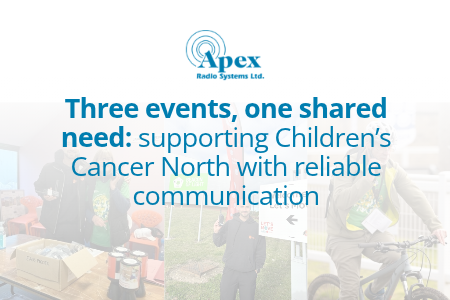
Three events, one shared need: supporting Children’s Cancer North with reliable communication A busy fundraising run, a remembrance event for bereaved families...


Call Us
Clear communication is essential in busy working environments. Whether you manage a retail store, oversee a construction site or coordinate a security team, your staff need instant, reliable contact with one another. Mobile phones are not always practical. They rely on network coverage, involve dialling and can slow down urgent communication.
Two-way radios solve that problem. With a single press of a button, teams can speak instantly.
However, when researching systems, most businesses quickly encounter the same question: licence free vs licensed radios – what is the difference, and which should you choose?
Although they look similar, these two types of radio operate in very different ways. The choice you make affects range, reliability, privacy and long-term value. In this guide, we explain everything you need to know in clear, straightforward language.
At their simplest, two-way radios allow people to communicate over radio frequencies rather than mobile networks. They are widely used across the UK in sectors such as retail, logistics, construction, education, hospitality and facilities management.
The key difference lies in the frequency they operate on.
Licence-free radios use public frequencies that anyone can access. Licensed radios operate on frequencies assigned by Ofcom, the UK communications regulator. That distinction may sound technical, but it has practical consequences for performance and reliability.
If your business depends on consistent communication, understanding this difference is critical.
Licence-free radios are designed for convenience. They can be purchased, switched on and used immediately without paperwork. In the UK, they operate on PMR446 frequencies, which are set aside specifically for short-range use.
Because these frequencies are public, no individual business owns them.
PMR446 radios are limited to 0.5 watts of transmission power and must use a fixed antenna. These restrictions are in place to prevent interference across users sharing the same band.
In practical terms, this means licence-free radios are intended for relatively short distances. They perform well in small buildings or contained sites but are not designed for wide-area coverage.
Since the channels are shared, other nearby businesses may also be transmitting on them. Most radios offer privacy codes, but these do not make conversations private — they simply filter out unwanted audio. Another user can still transmit on the same channel.
The main advantage is simplicity. There is no licence application, no waiting period and no ongoing regulatory fees. For small teams working within one building, this can be perfectly adequate.
They are also cost-effective. Initial purchase prices are lower than licensed systems, making them attractive for smaller budgets or temporary projects.
For example, a retail shop operating across one floor, or a café managing front and back-of-house staff, may find licence-free radios entirely sufficient.
The limitations become apparent as your communication needs increase.
Range is restricted by both power output and environmental conditions. Thick walls, metal shelving, machinery and urban congestion all reduce signal strength. In busy town centres, interference is common because multiple businesses may be using the same channels.
There is also no protection from disruption. If another nearby user occupies your channel, you have no priority access.
For businesses operating in safety-critical environments, this lack of control can present risk.
Licence-free radios are most suitable when:
They are popular in retail, hospitality, leisure centres and schools where coverage needs are modest.
Licensed radios operate on frequencies assigned by Ofcom. This means your business has authorised access to specific channels within a defined area.
Unlike licence-free radios, licensed models are not restricted to 0.5 watts. They can transmit at higher power levels, typically 4 or 5 watts for handheld devices, and much higher for base stations or vehicle units.
This increased power translates directly into improved coverage and reliability.
When you apply for a licence, Ofcom allocates frequencies based on your location and operational requirements. Depending on the licence type, you may share frequencies with others or have exclusive use in your area.
Because your channels are formally assigned, the risk of interference is greatly reduced.
Licensed systems can also incorporate repeaters. A repeater receives a transmission and rebroadcasts it at higher power from an elevated position. This dramatically extends range, often covering entire industrial estates, campuses or large construction projects.
There are several types of business radio licences.
A Simple UK Licence is cost-effective and suitable for many small-to-medium businesses. It allows operation across the UK on designated shared channels.
A Technically Assigned Licence provides greater control. Frequencies are coordinated for your specific location, reducing interference and improving performance.
Larger organisations may require area-defined or site-specific licences, particularly if wide-area coverage or networked systems are involved.
Choosing the correct licence requires technical knowledge and an understanding of your operational environment.
The most significant benefit is reliability. Stronger signals, clearer audio and reduced interference make licensed radios more dependable.
They also offer scalability. As your team grows or expands across multiple sites, your system can expand with it. Digital licensed systems can support advanced features such as:
For businesses where communication failure could impact safety or productivity, these advantages are substantial.
Licensed systems involve higher initial costs. There are also Ofcom fees, usually paid over several years.
However, when viewed over the long term, licensed systems often provide better value due to their durability and performance.
Licensed radios are particularly suited to construction sites, security operations, transport depots, logistics centres and event management. In these environments, coverage areas are larger and the consequences of missed communication are greater.
When comparing licence free vs licensed radios, the most noticeable difference is range.
Licence-free radios may achieve up to two kilometres in ideal open conditions. In real-world environments with buildings and obstructions, coverage is usually far less.
Licensed radios offer stronger and more consistent coverage. With repeaters, communication can extend across several kilometres or cover complex indoor facilities.
Audio clarity also differs. Licensed systems maintain stronger signals in noisy or built-up areas. This results in fewer dropped transmissions and clearer conversations.
From a cost perspective, licence-free radios appear cheaper at first. Yet businesses that experience interference or outgrow their system often find themselves replacing equipment sooner than expected.
Licensed radios require greater investment, but they provide a stable foundation for growth.
Manufacturers often advertise maximum range based on ideal outdoor conditions. In reality, performance depends heavily on environment.
Inside warehouses or multi-storey buildings, thick concrete and steel structures weaken signals. Licence-free radios may struggle to cover multiple floors or distant corners of large premises.
Licensed radios, with their higher power output, perform more reliably in these conditions.
Urban environments present further challenges. Competing signals, reflective surfaces and physical obstructions all affect coverage. Again, licensed systems tend to cope better.
Where extended coverage is required, repeaters can be installed. This is a major advantage of licensed systems and one that licence-free radios cannot offer under standard regulations.
If you remain within PMR446 frequencies, no licence is required. The moment you operate outside those frequencies, you must hold a valid Ofcom licence.
Using licensed frequencies without authorisation can result in enforcement action, fines and equipment seizure.
The application process for a Simple UK Licence is usually straightforward. More complex licences may involve coordination to avoid interference with existing users.
Licence costs vary, but many business licences cover a five-year period, making them cost-effective over time.
Licensing relates to frequency, not technology. Both digital and analogue radios can be either licence-free or licensed.
Digital systems offer improved audio clarity and better battery efficiency. They also enable advanced features such as encryption and tracking.
If privacy is important, digital licensed systems provide a far higher level of security than licence-free alternatives.
The right choice depends on your operational demands.
If your team works within a small building and communication is convenient rather than critical, licence-free radios may meet your needs.
If you manage multiple teams, operate outdoors or require dependable coverage across a large area, licensed radios are often the better investment.
Many businesses start with licence-free systems and upgrade once they encounter limitations such as interference or restricted range.
A professional assessment can prevent costly mistakes and ensure your system matches your operational reality.
Selecting between licence free vs licensed radios is not simply about equipment. It requires understanding your site layout, workforce size and future growth plans.
Apex Radio Systems provides expert guidance tailored to UK businesses. Rather than offering a one-size-fits-all solution, we assess your operational environment in detail.
We support you through the Ofcom licensing process, ensuring full compliance and minimal disruption. Where required, we carry out site surveys and coverage testing to confirm performance before installation.
Our team designs both analogue and digital systems, from small retail setups to large-scale, repeater-backed networks. Installation, programming and long-term maintenance are all handled professionally, giving you confidence that your communication system will perform when it matters most.
As your organisation grows, your radio system can grow with you. With ongoing UK-based support, Apex Radio Systems ensures your investment delivers long-term reliability and value.
Many businesses ask whether licence-free radios are private. The answer is no. While privacy codes reduce unwanted noise, transmissions can still be heard by others on the same channel.
Another common question concerns upgrades. In most cases, licence-free radios cannot simply be converted to licensed operation. A new system is usually required.
Businesses also ask about sound quality. Licensed radios typically deliver clearer and more consistent audio, particularly in challenging environments.
When weighing up licence free vs licensed radios, the decision ultimately comes down to reliability, coverage and future planning.
Licence-free radios offer simplicity and affordability for smaller environments. Licensed systems provide stronger performance, reduced interference and room to grow.
For businesses where communication supports safety, productivity and reputation, investing in the right system from the start can prevent frustration and costly upgrades later.
If you are unsure which direction to take, Apex Radio Systems can provide clear, practical advice and deliver a solution tailored to your needs – ensuring your team stays connected, wherever they work. Speak to our team today!
Apex Radio Systems
Two-way radio sales, hire, licensing and repairs for UK businesses since 1990. Motorola Platinum Dealer with offices in Gateshead, Teesside and Cardiff.
In this article
Speak to a specialist
Our team will talk through your site and recommend the right radios, cameras or scheme.
Share this article
Keep reading
Three events, one shared need: supporting Children’s Cancer North with reliable communication A busy fundraising run, a remembrance event for bereaved families...
Apex Radio Systems is preparing to exhibit at the British BIDs National Conference 2026. We’re exploring how better communication, intelligence and partnership...
When teams depend on two-way radio throughout the working day, one of the most important questions is simple: Can everyone hear the...
Get a free quote
Whether you need a handful of radios or a site-wide system, our team will come back to you with clear, no-obligation advice.
Call us, Monday to Friday, 09:00 to 17:00

On all orders over £200 (for web orders only)

Help with product sales & support

Certification: ISO 9001

Speak to your Support Hero